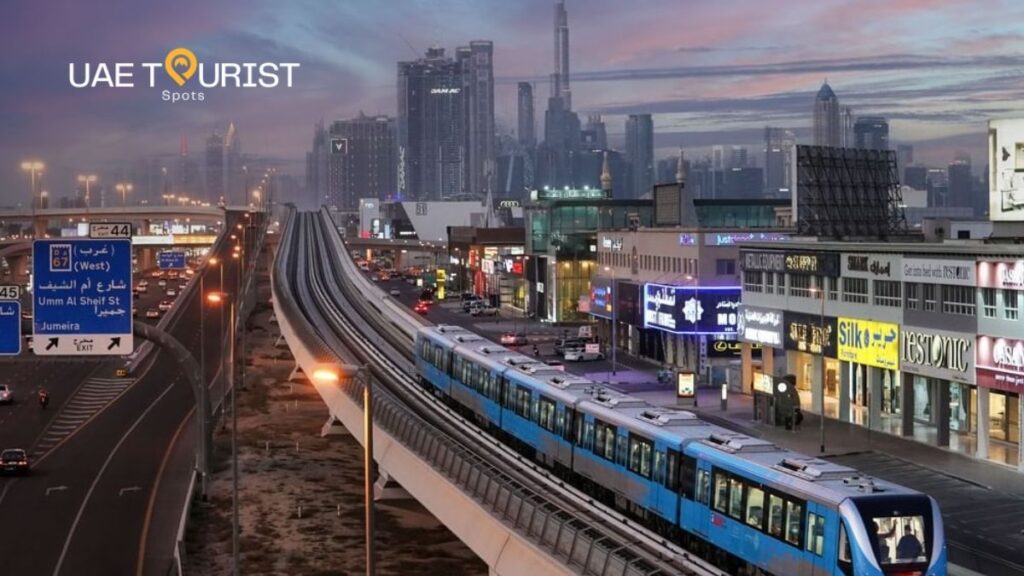
Dubai is a city where attractions can sit many kilometres apart, so choosing the right way to get around can make a noticeable difference to both your budget and your day. For many visitors, the Dubai Metro is the simplest option. It is clean, air-conditioned, fully automated and connects Dubai International Airport with Downtown Dubai, Deira, Bur Dubai, Dubai Marina, Expo City and several major shopping and business districts.
This Dubai Metro Guide covers everything you need for travelling in 2026, including operating hours, Nol cards, ticket prices, fare zones, the Red and Green lines, current station names, airport connections and useful rules for first-time passengers.
The system currently operates through the Red Line and Green Line, with the Route 2020 extension forming part of Red Line services. RTA’s current network map lists 53 operational metro stations when the shared Union and BurJuman interchange stations are counted once. Dubai’s Blue Line is under construction and is scheduled to open on 9 September 2029, so it should not be confused with the lines available to passengers in 2026.
Table of Contents
- Dubai Metro overview
- Dubai Metro timings in 2026
- Dubai Metro lines explained
- Dubai Metro stations
- Dubai Metro map and fare zones
- Nol cards and ticket prices
- How to use the Dubai Metro
- Dubai Metro from the airport
- Gold Class and women and children cabins
- Luggage, rules and fines
- Best time to travel
- Metro stations for major Dubai attractions
- Practical travel tips
- Frequently asked questions
Dubai Metro Overview
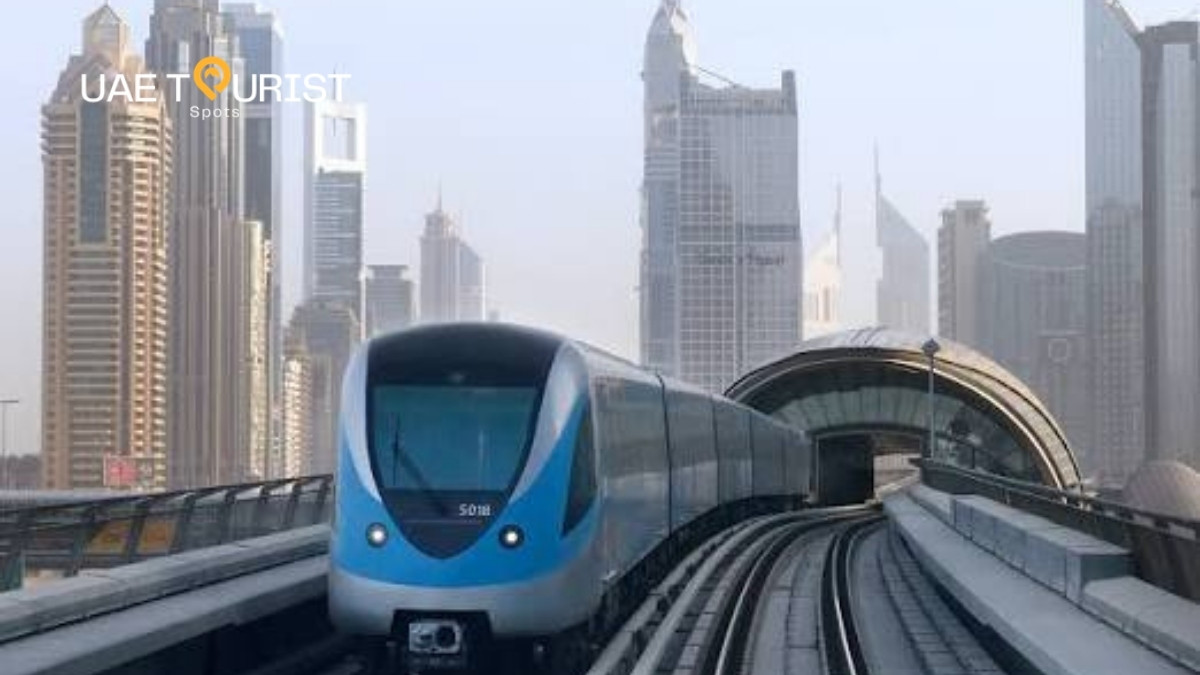
Dubai Metro is operated by Dubai’s Roads and Transport Authority, better known as RTA. The network uses driverless trains and is designed to connect with buses, taxis, Dubai Tram and other public transport services.
For tourists, its biggest advantage is that many of Dubai’s most visited districts lie directly along the Red Line. You can travel from Dubai International Airport to areas such as Downtown Dubai, the Dubai World Trade Centre, Mall of the Emirates and Dubai Marina without relying on a taxi for the entire journey.
The Green Line is particularly useful for exploring older parts of the city, including Deira, the Gold Souk, Al Ras, Al Ghubaiba and areas close to Dubai Creek.
RTA currently identifies Union and BurJuman as the two interchange stations between the Red and Green lines. Sobha Realty and DMCC also provide convenient connections toward Dubai Tram services in the Marina area.
Dubai Metro Timings 2026
The regular opening hours published by RTA for all Dubai Metro lines are:
| Day | Dubai Metro Operating Hours |
| Monday to Thursday | 5:00 AM to 12:00 midnight |
| Friday | 5:00 AM to 1:00 AM the following day |
| Saturday | 5:00 AM to 12:00 midnight |
| Sunday | 8:00 AM to 12:00 midnight |
Do All Stations Have the Same First and Last Train?
Not necessarily.
The hours above refer to the overall opening schedule. The first and last train at an individual station can differ depending on your direction and destination. If you need to catch a late-night train, particularly when travelling to the airport, Expo City or one of the outer stations, check the RTA timetable or S’hail app before leaving.
RTA also changes operating hours for some public holidays, major celebrations and special events. For example, extended services have been announced during certain Eid periods.
For an early-morning flight, do not assume the metro will run throughout the night. Dubai Metro is not a 24-hour service.
Dubai Metro Lines Explained
Red Line
The Dubai Metro Red Line is the line most tourists use.
It runs through the city’s main north-south transport corridor, connecting Dubai International Airport and Deira with Downtown Dubai, Sheikh Zayed Road, Al Barsha, Dubai Marina, Jebel Ali and the Route 2020 extension.
RTA currently lists Red Line services between Centrepoint (R11) and Expo 2020 (R76) / Life Pharmacy (R42). Because the western side of the route has different destinations, always look at the destination shown on the train and platform screens rather than boarding simply because the train is on the Red Line.
Some of the most useful Red Line stations for tourists include:
- Airport Terminal 3
- Airport Terminal 1
- City Centre Deira
- Union
- BurJuman
- World Trade Center
- Emirates Towers
- Financial Centre
- Burj Khalifa / Dubai Mall
- Business Bay
- Mall of the Emirates
- Dubai Internet City
- Sobha Realty
- DMCC
- Ibn Battuta
- The Gardens
- Discovery Gardens
- Al Furjan
- Dubai Investment Park
- Expo 2020
Green Line
The Dubai Metro Green Line is particularly useful if your itinerary includes Old Dubai.
It operates between e& (G11) and Creek (G30) and passes through districts including Al Qusais, Deira, the Gold Souk, Al Ras, Al Ghubaiba, BurJuman, Oud Metha and Dubai Healthcare City.
Tourists visiting the traditional souks, Dubai Creek and the historic districts around Bur Dubai often find the Green Line more useful than the Red Line.
Route 2020
Route 2020 is an extension connected to the Red Line rather than a completely separate tourist metro system.
The extension serves:
- The Gardens
- Discovery Gardens
- Al Furjan
- Jumeirah Golf Estates
- Dubai Investment Park
- Expo 2020
The project added approximately 15 kilometres to the system and was developed to connect communities around the former Expo site with the wider metro network.
The Expo 2020 station now provides convenient access to Expo City Dubai.
What About the Dubai Metro Blue Line?
You may see the Blue Line on news reports and future transport maps, but it is not open in 2026.
The 30-kilometre Blue Line is under construction and will include 14 stations, with connections planned at Creek and Centrepoint. RTA has scheduled its opening for 9 September 2029.
A Gold Line has also been approved for a later phase, but it is not part of the metro system available to tourists in 2026.
Dubai Metro Stations List 2026
One useful tip is to remember the station code as well as the station name. Dubai periodically sells naming rights to stations, meaning names familiar from an old blog post or printed map may no longer match current signage.
For example, Jebel Ali Metro Station was renamed National Paints Metro Station in 2025.
Red Line Stations
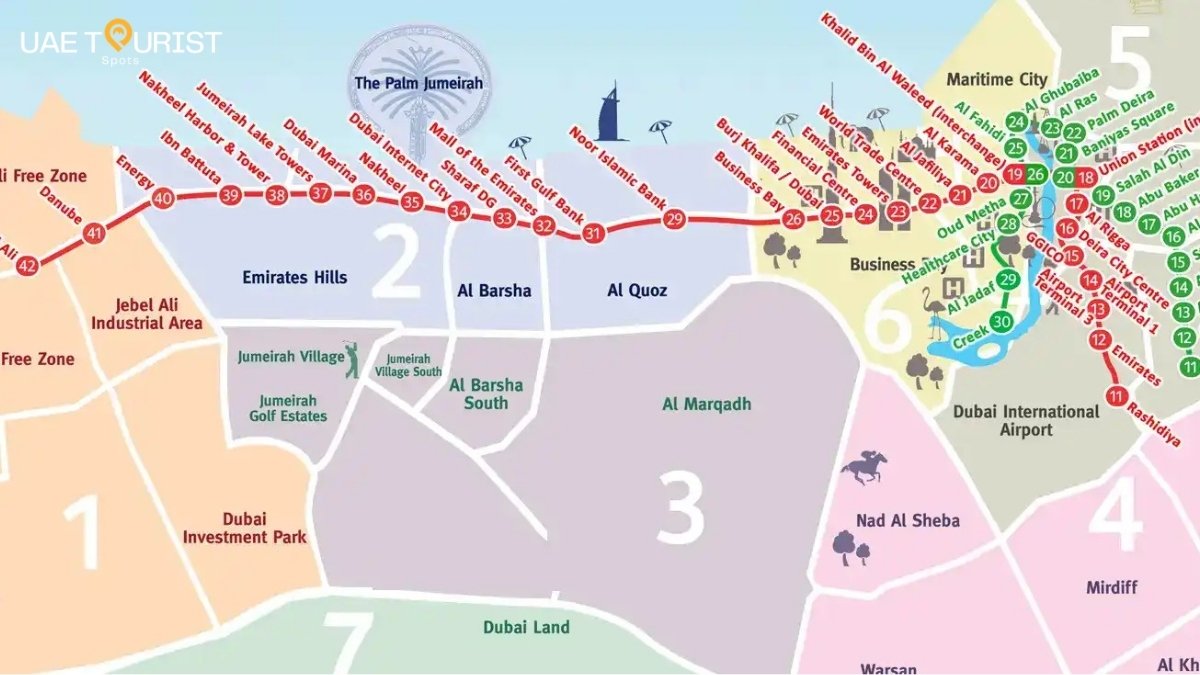
The current RTA station map lists:
R11 Centrepoint
R12 Emirates
R13 Airport Terminal 3
R14 Airport Terminal 1
R15 Al Garhoud
R16 City Centre Deira
R17 Al Rigga
R18 Union
R19 BurJuman
R20 ADCB
R21 max
R22 World Trade Center
R23 Emirates Towers
R24 Financial Centre
R25 Burj Khalifa / Dubai Mall
R26 Business Bay
R29 ONPASSIVE
R31 Equiti
R32 Mall of the Emirates
R33 InsuranceMarket
R34 Dubai Internet City
R35 Al Fardan Exchange
R36 Sobha Realty
R37 DMCC
R38 National Paints
R39 Ibn Battuta
R40 Energy
R41 Danube
R42 Life Pharmacy
R70 The Gardens
R71 Discovery Gardens
R72 Al Furjan
R73 Jumeirah Golf Estates
R74 Dubai Investment Park
R76 Expo 2020
Green Line Stations
G11 e&
G12 Al Qusais
G13 Dubai Airport Free Zone
G14 Al Nahda
G15 Stadium
G16 Al Qiyadah
G17 Abu Hail
G18 Abu Baker Al Siddique
G19 Salah Al Din
G20 Union
G21 Baniyas Square
G22 Gold Souq
G23 Al Ras
G24 Al Ghubaiba
G25 Sharaf DG
G26 BurJuman
G27 Oud Metha
G28 Dubai Healthcare City
G29 Al Jadaf
G30 Creek
Dubai Metro Map and Fare Zones
Dubai’s public transport fare system divides the emirate into seven zones.
Your fare is calculated according to how many zones your journey covers rather than simply how many stations you pass.
RTA groups journeys into three main fare tiers:
Tier 1
Travel within one zone, or certain short journeys crossing into another zone.
Tier 2
A journey beginning in one zone and ending in an adjacent zone.
Tier 3
A longer journey crossing more than two zones.
You normally do not have to calculate the fare yourself when using a Silver, Gold or Personal Nol card. Tap in at your starting station and tap out at your destination, and the system deducts the appropriate fare automatically.
Transfers Between Metro, Bus and Tram
A useful feature of the Nol system is integrated transfers.
If you leave the Metro and transfer to another eligible RTA mode within 30 minutes, your journey can be calculated as one combined trip based on the zones crossed. RTA permits up to three transfers within a journey, subject to its fare rules.
This is particularly helpful when reaching places such as JBR or Palm Jumeirah, where Metro and Tram connections are often used together.
Dubai Metro Ticket Prices in 2026
You cannot simply pay cash at the metro gate. Passengers need an appropriate Nol card or Nol Red Ticket.
RTA’s current regular fares are:
| Journey | Silver/Personal Nol | Gold Nol | Red Ticket Regular | Red Ticket Gold |
| Within 1 zone | AED 3 | AED 6 | AED 4 | AED 8 |
| 2 adjacent zones | AED 5 | AED 10 | AED 6 | AED 12 |
| More than 2 zones | AED 7.50 | AED 15 | AED 8.50 | AED 17 |
Nol Silver Card
For most visitors staying several days, the Silver Nol Card is the most practical choice.
The card costs AED 25, including AED 19 of travel credit, and the current RTA version is valid for five years.
The system automatically calculates your correct fare when you tap out.
Nol Gold Card
The Gold card also costs AED 25 with AED 19 credit, but journeys in the dedicated Metro Gold Class cabin are charged at the higher Gold fare.
Gold Class can be worthwhile if you value a quieter cabin, wider seating and panoramic views, particularly on a longer trip along Sheikh Zayed Road.
Nol Red Ticket
The Red Ticket is a disposable paper ticket aimed mainly at occasional travellers and tourists.
The ticket itself costs AED 2, after which you load the required journey or pass. It can be recharged for up to 10 journeys or five daily passes.
For someone taking only one or two Metro trips during a short stopover, this can be simpler than purchasing a reusable card.
Dubai Metro One-Day Pass
RTA lists the Nol Red Ticket one-day pass at:
- AED 20 for Regular Class
- AED 40 for Gold Class
It allows unlimited eligible journeys during that day and is valid until the end of the same travel date.
If you plan to spend an entire day moving between several attractions, compare the daily pass against paying for individual journeys.
Seven-Day Passes
For longer visits, Silver-card travel passes are currently priced at:
- AED 50: one zone
- AED 80: two zones
- AED 110: all zones
Gold Class equivalents cost AED 100, AED 160 and AED 220. Anonymous Silver and Gold cards are eligible for seven-day travel passes, while longer 30-, 90- and 365-day passes require registration.
How to Use Dubai Metro
Using the Metro for the first time is straightforward.
Step 1: Buy or Top Up Your Nol Card
Ticket offices and vending machines are available at Metro stations. RTA also supports Nol services through its digital channels.
Step 2: Check Your Balance
RTA requires at least AED 7.50 on a Nol card to enter the Metro system, although it recommends keeping more credit available to avoid problems during the journey.
Step 3: Tap In
Place the Nol card on the reader at the station gate and wait for confirmation before entering.
Step 4: Check Your Direction
Look at the line, station code and final destination displayed on signs and platform screens.
This matters particularly on Red Line journeys toward the western end of the network.
Step 5: Tap Out
Always tap the same Nol card at your destination gate. Your fare is calculated and deducted when you exit.
Failing to correctly check in or out can result in penalties.
Dubai Metro From Dubai International Airport
One of the strongest reasons to use the Metro is its direct connection with Dubai International Airport (DXB).
The Red Line serves:
- Airport Terminal 1 Station
- Airport Terminal 3 Station
Dubai Airports confirms that both Terminals 1 and 3 have direct Red Line access.
From DXB to Downtown Dubai
Board the Red Line in the appropriate direction and travel to Burj Khalifa / Dubai Mall Station.
From the station, follow the signs through the air-conditioned pedestrian connection toward Dubai Mall.
From DXB to Dubai Marina
Stay on the Red Line toward the western side of Dubai and use DMCC or Sobha Realty, depending on your hotel or destination.
For parts of JBR and the Marina waterfront, transfer to Dubai Tram or use a short taxi ride.
What About Dubai Airport Terminal 2?
Terminal 2 does not have its own Metro station. Depending on your destination and arrival time, you will generally need a taxi, bus or other connection to reach the Metro network.
If you arrive very late at night or before Sunday morning Metro services begin, a taxi may be more practical than waiting.
Gold Class, Women and Children Cabins
Dubai Metro trains contain different cabin types.
Gold Class
Gold Class is reserved for passengers holding the appropriate Gold fare. RTA describes these cabins as offering wider seating and panoramic views.
Do not enter Gold Class with a standard Silver Nol card unless you have the appropriate Gold entitlement.
Women and Children Cabin
A separate cabin is designated for women and children.
Male passengers should pay attention to the markings on the platform and inside the train because entering or sitting in a section reserved for a specific passenger category can result in a fine.
General Cabins
The remaining sections are available to regular passengers.
During busy periods, waiting for the next train can sometimes be more comfortable than forcing yourself into a crowded carriage, especially when carrying luggage.
Dubai Metro Luggage Rules
Dubai Metro is convenient for airport passengers, but luggage must remain manageable.
Dubai Airports advises passengers travelling from DXB that up to two pieces of luggage, including hand luggage, can be carried, while RTA guidance requires luggage to be stored in the dedicated luggage areas.
If you are travelling with several large suitcases, young children and a stroller, or bulky equipment, a taxi may be easier.
Important Dubai Metro Rules and Fines
Dubai Metro is noticeably orderly, and the rules are actively enforced.
Among the most useful rules for visitors to remember:
- Do not eat, drink or chew gum in prohibited Metro areas.
- Do not smoke inside trains or stations.
- Use only the cabin category you are entitled to enter.
- Always tap your Nol card correctly.
- Do not block train doors.
- Allow passengers to leave before boarding.
- Keep luggage out of aisles and doorways.
- Do not misuse emergency equipment.
- Follow station and inspector instructions.
RTA’s published rail guidance lists fines for violations including fare evasion, using restricted cabins and eating or drinking in prohibited areas. Misuse of emergency equipment can carry significantly higher penalties.
Best Time to Use Dubai Metro
Dubai Metro operates throughout the year, so there is no specific season when you cannot use it.
For sightseeing, however, late morning through mid-afternoon is often easier than travelling during the main commuter rush.
RTA itself recommends planning journeys during off-peak periods where possible to avoid congestion.
If you have flexibility, avoid joining the busiest stations immediately before or after the normal office commute. Friday schedules are slightly different, while Sunday service begins later at 8:00 AM.
During the hotter months, the Metro becomes particularly useful because trains and stations are air-conditioned. Just remember that the final walk between a station and an attraction can still be outdoors.
Location and How to Reach Dubai Metro
There is no single Dubai Metro location. The network stretches across much of the city.
For visitors, common entry points include:
- Dubai International Airport Terminals 1 and 3
- Union
- BurJuman
- Burj Khalifa / Dubai Mall
- Mall of the Emirates
- Sobha Realty
- DMCC
- Expo 2020
If your accommodation is not within comfortable walking distance of a station, combine the Metro with an RTA feeder bus, Dubai Tram or a short taxi ride.
The S’hail app is especially useful because it can plan journeys involving more than one form of public transport.
Attractions Near Dubai Metro Stations
Burj Khalifa and Dubai Mall
Station: Burj Khalifa / Dubai Mall, Red Line
This is the obvious station for Burj Khalifa, At The Top, Dubai Mall and the Downtown Dubai area.
Allow extra walking time. The station name can make first-time visitors assume they will emerge directly beside Burj Khalifa, but you still need to follow the pedestrian connection into the mall district.
Museum of the Future
Station: Emirates Towers, Red Line
Emirates Towers is one of the most convenient Metro stops for the Museum of the Future and the surrounding Sheikh Zayed Road district.
Mall of the Emirates
Station: Mall of the Emirates, Red Line
The station connects directly with one of Dubai’s largest shopping centres and provides access to Ski Dubai.
Dubai Marina
Stations: DMCC or Sobha Realty, Red Line
Both are useful depending on which part of Dubai Marina you plan to explore. Dubai Tram provides additional connections around the Marina and JBR.
Gold Souk
Station: Gold Souq, Green Line
For traditional shopping, jewellery stores and the atmosphere of Deira, the Green Line provides convenient access to the Dubai Gold Souk area.
Dubai Creek and Old Dubai
Stations: Al Ras, Al Ghubaiba, Sharaf DG or Creek, depending on your itinerary
This side of the Metro is excellent for combining rail travel with an abra crossing, heritage districts and the older trading areas around Dubai Creek.
Expo City Dubai
Station: Expo 2020, Red Line
The Expo 2020 station is the easiest public transport option for reaching Expo City Dubai.
Palm Jumeirah
The Metro does not travel along the Palm itself.
A common public transport route is to travel toward Dubai Marina, connect with the Tram and continue toward Palm Jumeirah, where further connections such as the Palm Monorail or a taxi may be required.
Practical Dubai Metro Travel Tips
Keep your Nol card separate when tapping. If several contactless cards are pressed against the reader together, the gate may fail to recognise the correct one.
Use station codes as a backup. Commercial station names can change, but codes such as R25 or G22 make it easier to recognise the correct stop on updated maps.
Check your destination before boarding the Red Line. The western side has different terminal destinations, so never assume every Red Line train follows exactly the same final route.
Top up before the evening rush. Standing at a ticket machine with a queue behind you is an unnecessary way to lose sightseeing time.
Allow time for station exits. Some stations are large, and choosing the wrong exit can add a substantial walk.
Do not underestimate Dubai’s heat. A location that appears “near the Metro” on a map can still involve a 10- or 15-minute outdoor walk.
Use Metro plus taxi strategically. Taking the Metro for the long part of a journey and a taxi for the final few kilometres often gives a good balance between cost and convenience.
Check special-event schedules. New Year’s Eve, Eid holidays and major events can affect timings, station access and crowd levels.
Frequently Asked Questions
1. What time does Dubai Metro open in 2026?
From Monday to Saturday, regular Metro service starts at 5:00 AM, while Sunday service starts at 8:00 AM. Monday to Thursday and Saturday services normally end at midnight, while Friday runs until 1:00 AM the next day.
2. How much does Dubai Metro cost?
With a regular Silver or Personal Nol card, standard fares are currently AED 3, AED 5 or AED 7.50, depending on the fare zones crossed.
3. Can tourists buy a Nol card?
Yes. Tourists can buy Nol cards and Red Tickets from Metro ticket offices and vending machines. For several days of regular sightseeing, a Silver Nol card is usually the most convenient option.
4. Can I pay cash on Dubai Metro?
No. You need a valid Nol card or Nol Red Ticket to pass through the Metro gates. RTA does not accept cash as a direct fare payment for boarding the Metro.
5. Does Dubai Metro go to the airport?
Yes. The Red Line serves Dubai International Airport Terminal 1 and Terminal 3. Terminal 2 does not have a direct Metro station.
6. Does Dubai Metro go to Burj Khalifa?
Yes. Use Burj Khalifa / Dubai Mall Station (R25) on the Red Line, then follow the signs toward Dubai Mall and Downtown Dubai.
7. Does Dubai Metro run 24 hours?
No. Normal service ends around midnight on most days and at 1:00 AM after Friday service. Holiday and special-event hours can vary.
8. Is there a Dubai Metro day pass?
Yes. RTA lists a Red Ticket one-day pass at AED 20 for Regular Class and AED 40 for Gold Class.
9. Are children free on Dubai Metro?
RTA’s current fare information states that children aged five and below travel free.
10. Is Dubai Metro safe for tourists?
Dubai Metro is widely used by residents and visitors and has controlled station access, CCTV, dedicated Metro security measures and clearly marked passenger areas. Normal precautions with luggage, phones and personal belongings are still sensible.
Conclusion
For most visitors, learning the Dubai Metro takes only one or two journeys. The Red Line covers many of the city’s modern attractions and major hotel districts, while the Green Line makes exploring Deira, Dubai Creek and Old Dubai considerably easier.
The most important things to remember from this Dubai Metro Guide are simple: buy the right Nol card, keep enough credit on it, tap in and out correctly, check your train’s destination and confirm late-night or holiday timings before travelling.
Used together with Dubai Tram, buses and occasional taxis, the Metro can significantly reduce transport costs without limiting how much of the city you see. For a first visit to Dubai in 2026, it remains one of the most practical ways to move between the airport, major attractions, shopping districts and neighbourhoods across the city.